Published April 10, 2023
| Version v1
Journal article
Open
Propagating motor cortical patterns of excitability are ubiquitous across human and non-human primate movement initiation
Creators

- 1. University of Chicago
- 2. University of Pittsburgh
Description
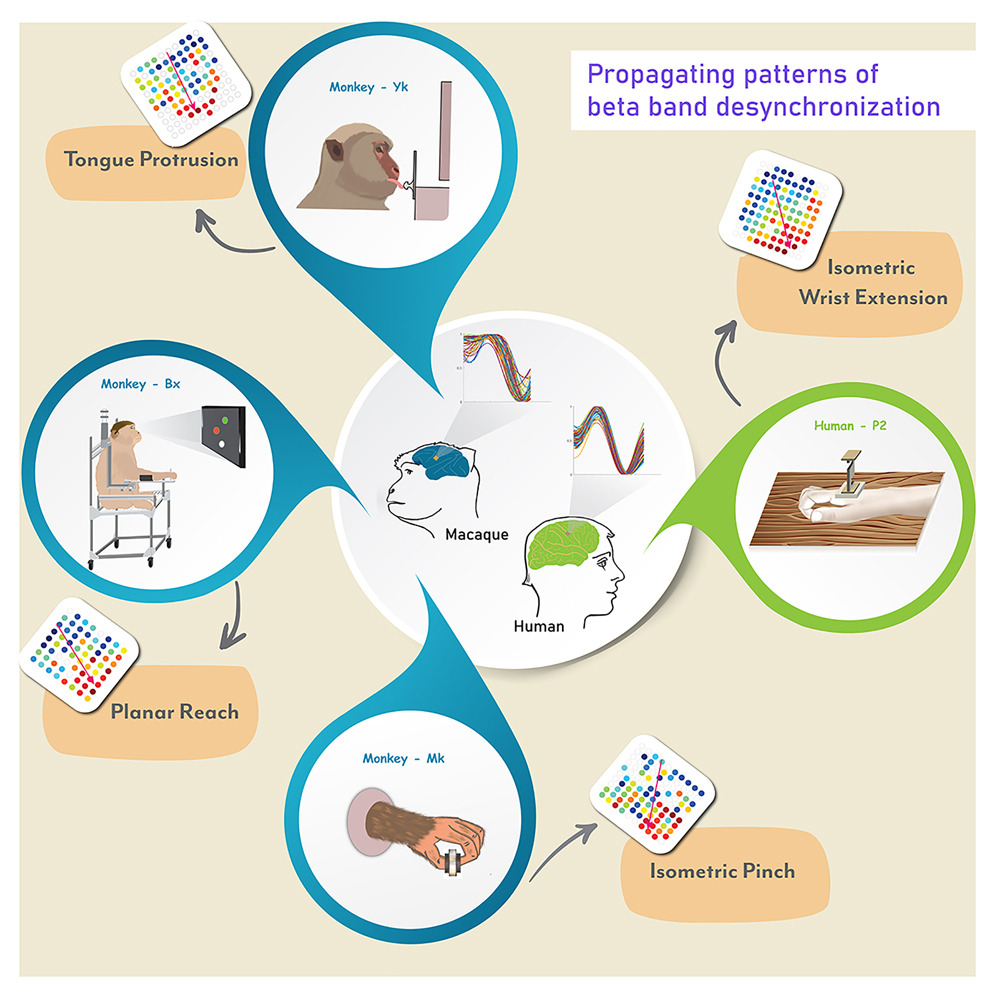
A spatiotemporal pattern of excitability propagates across the primary motor cortex prior to the onset of a reaching movement in non-human primates. If this pattern is a necessary component of voluntary movement initiation, it should be present across a variety of motor tasks, end-effectors, and even species. Here, we show that propagating patterns of excitability occur during the initiation of precision grip force and tongue protrusion in non-human primates, and even isometric wrist extension in a human participant. In all tasks, the directions of propagation across the cortical sheet were bimodally distributed across trials with modes oriented roughly opposite to one another. Propagation speed was unimodally distributed with similar mean speeds across tasks and species. Additionally, propagation direction and speed did not vary systematically with any behavioral measures except response times indicating that this propagating pattern is invariant to kinematic or kinetic details and may be a generic movement initiation signal.
Data availability
Monkey Data: Mendeley Data: https://data.mendeley.com/datasets/3b58rk3jp8/draft?a=da69fe10-5dea-4c8c-8418-acd2901fcdb4
Human Data: DABI: https://dabi.loni.usc.edu/dsi/UH3NS107714/J8DVJ0JZA7DY
Files
Propagating-motor-cortical-patterns-of-excitability.pdf
Additional details
Identifiers
- DOI
- 10.1016/j.isci.2023.106518
- Other
- oai:uchicago.tind.io:5765
Funding
- National Institute of Neurological Disorders and Stroke
- R01 NS045853
- National Institute of Neurological Disorders and Stroke
- R01 NS111982
- National Institute of Neurological Disorders and Stroke
- UH3NS107714