Published January 31, 2023
| Version v1
Journal article
Open
A context-dependent switch from sensing to feeling in the primate amygdala
Creators

- 1. University of Arizona
- 2. University of Chicago
Description
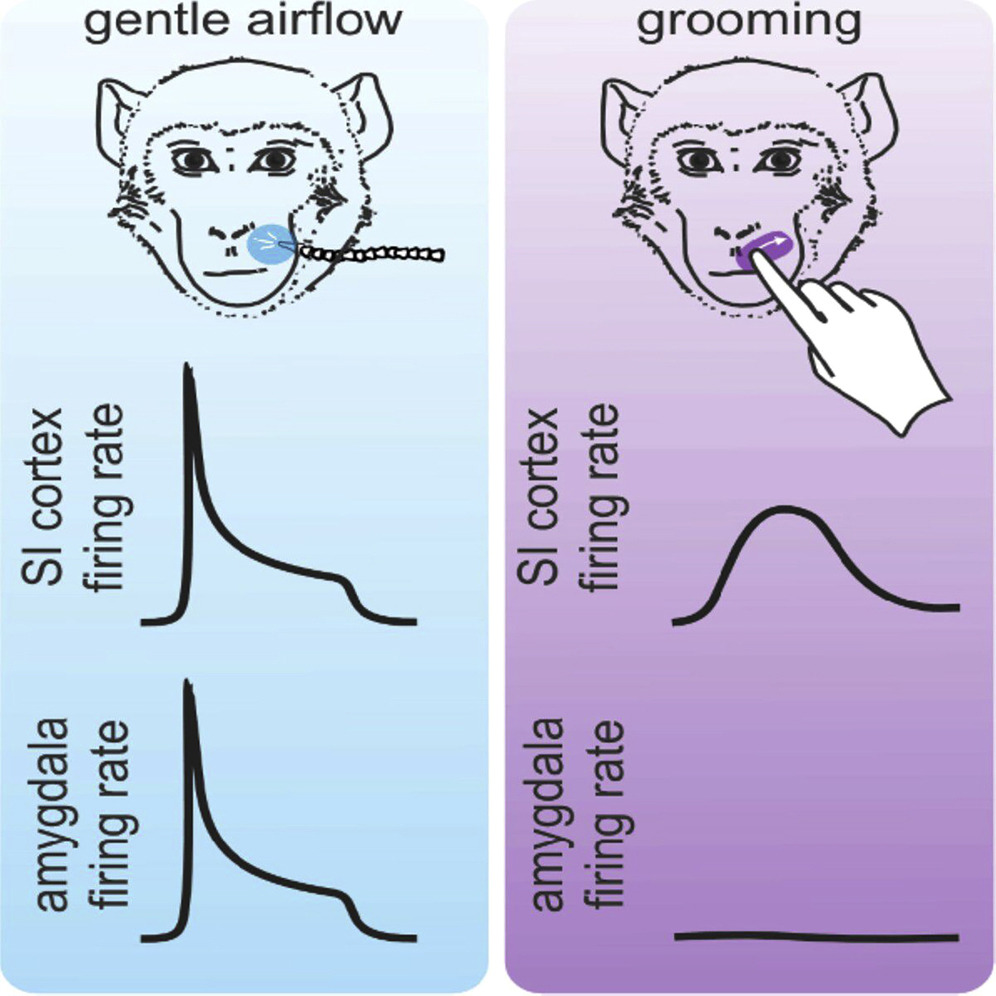
The skin transmits affective signals that integrate into our social vocabulary. As the socio-affective aspects of touch are likely processed in the amygdala, we compare neural responses to social grooming and gentle airflow recorded from the amygdala and the primary somatosensory cortex of non-human primates. Neurons in the somatosensory cortex respond to both types of tactile stimuli. In the amygdala, however, neurons do not respond to individual grooming sweeps even though grooming elicits autonomic states indicative of positive affect. Instead, many show changes in baseline firing rates that persist throughout the grooming bout. Such baseline fluctuations are attributed to social context because the presence of the groomer alone can account for the observed changes in baseline activity. It appears, therefore, that during grooming, the amygdala stops responding to external inputs on a short timescale but remains responsive to social context (or the associated affective states) on longer time scales.
Data availability
All data reported in this paper will be shared by the lead contact upon request.
This paper does not report original code.
Any additional information required to reanalyze the data reported in this paper is available from the lead contact upon request.
Files
Context-dependent-switch-from-sensing-to-feeling-in-the-primate-amygdala.pdf
Additional details
Identifiers
- DOI
- 10.1016/j.celrep.2023.112056
- Other
- oai:uchicago.tind.io:7440
Funding
- National Institutes of Health
- 1R56MH115681
- National Institutes of Health
- R01MH121009