Published September 7, 2023
| Version v1
Journal article
Open
Neoarchean environments associated with the emplacement of a large igneous province: Insights from the Carajás Basin, Amazonia Craton
Creators

- 1. Universidade de São Paulo
- 2. University of Chicago
- 3. Universidade Federal de Ouro Preto
- 4. University of Queensland
Description
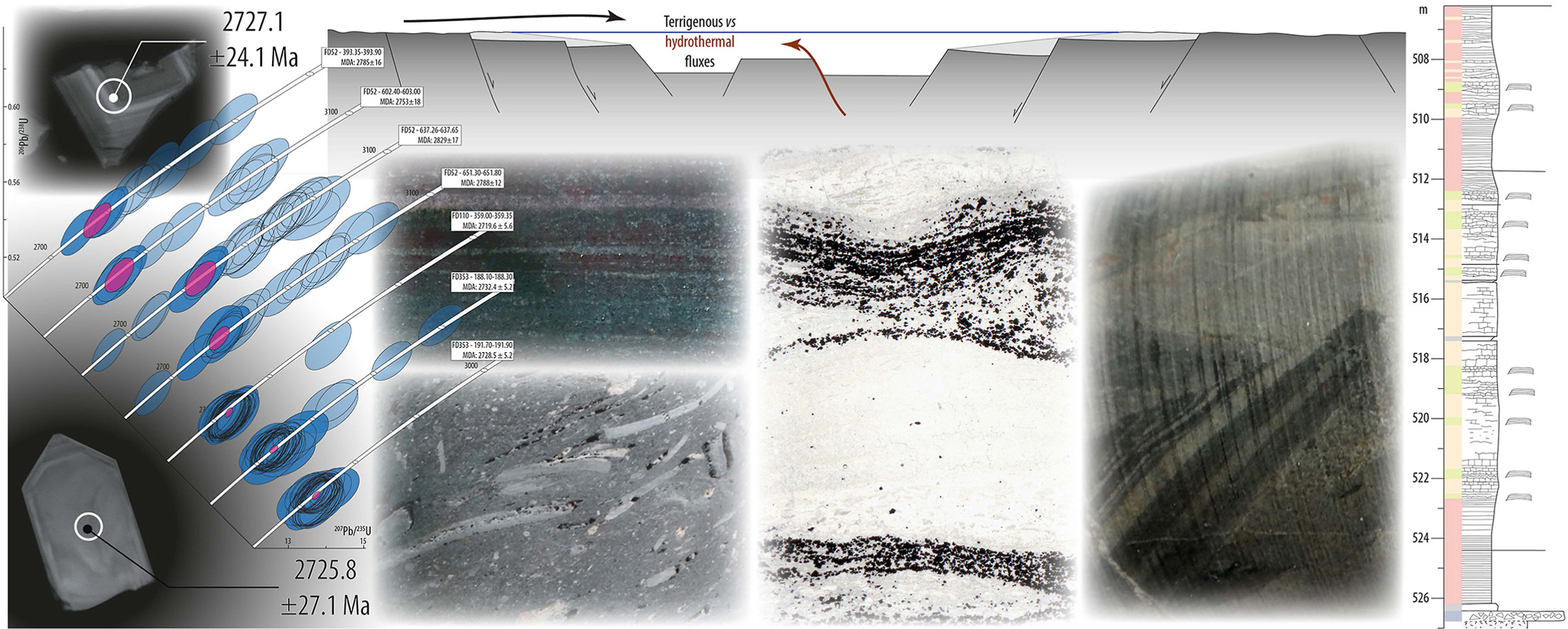
The emplacement of Large Igneous Provinces (LIPs) during the Neoarchean is thought to have influenced the Earth's surface by modulating global climate and the supply of nutrients to the oceans. However, the links between Neoarchean LIPs and Earth's surface changes are complex and not fully understood due to a lack of sedimentological constraints documenting the relationships between magmatic activity and concomitant depositional environments. At ca. 2.75 Ga, the Amazonia Craton witnessed the emplacement of the Parauapebas LIP, which is mainly composed of vesicular basalts and associated volcaniclastic rocks. The Carajás Formation conformably overlies the basalts of the Parauapebas LIP. It comprises extensive iron formations (IFs) interbedded with minor carbonate and volcaniclastic horizons, which were deposited in various shallow to deep-water settings. Zircon U–Pb dating of volcaniclastic layers yielded ages between 2732 ± 5 Ma and 2720 ± 6 Ma, which indicates that the volcanic activity continued 30–40 Myrs after the main peak in magmatic activity of the Parauapebas LIP. Above the Carajás Formation, the Igarapé Bahia Group consists mainly of terrigenous sediments that are interleaved at their base with minor IFs. This group does not preserve evidence of contemporaneous volcanic activity and comprises detrital zircon populations with ages between ca. 3.0 and 2.7 Ga. The few IFs horizons at the base of the Igarapé Bahia Group could reflect a long-lasting hydrothermal activity linked with the emplacement of the Parauapebas LIP. This LIP thus exerted a major control on depositional environments both in space and time by favoring the deposition of IFs (e.g., in shallow to deep-water settings) during a period that exceeded 30 Myrs.
Data availability
Supplementary information is archived at the Pangea data repository at https://doi.org/10.1594/PANGAEA.931156.Files
Neoarchean-environments-associated-with-the-emplacement-of-a-large-igneous-province.pdf
Additional details
Identifiers
- DOI
- 10.1016/j.jsames.2023.104574
- Other
- oai:uchicago.tind.io:7974
Funding
- Fundação de Amparo à Pesquisa do Estado de São Paulo (FAPESP)
- 2015/16235-2
- Fundação de Amparo à Pesquisa do Estado de São Paulo (FAPESP)
- 2018/02645-2
- Fundação de Amparo à Pesquisa do Estado de São Paulo (FAPESP)
- 2018/14617-3
- Fundação de Amparo à Pesquisa do Estado de São Paulo (FAPESP)
- 2018/05892-0
- Fundação de Amparo à Pesquisa do Estado de São Paulo (FAPESP)
- 2019/17732-0
- Fundação de Amparo à Pesquisa do Estado de São Paulo (FAPESP)
- 2019/16066-7
- Fundação de Amparo à Pesquisa do Estado de São Paulo (FAPESP)
- 2019/16271-0
- Fundação de Amparo à Pesquisa do Estado de São Paulo (FAPESP)
- 2019/12132-5
- Fundação de Amparo à Pesquisa do Estado de São Paulo (FAPESP)
- 2021/10949-4
- Conselho Nacional de Desenvolvimento Científico e Tecnológico (CNPq)
- 308045/2013-0
- Conselho Nacional de Desenvolvimento Científico e Tecnológico (CNPq)
- 307353/2019-2
- Fundação de Amparo à Pesquisa do Minas Gerais (FAPEMIG)
- APQ-03793-16