Published May 26, 2023
| Version v1
Journal article
Open
Algae drive convergent bacterial community assembly at low dilution frequency

Description
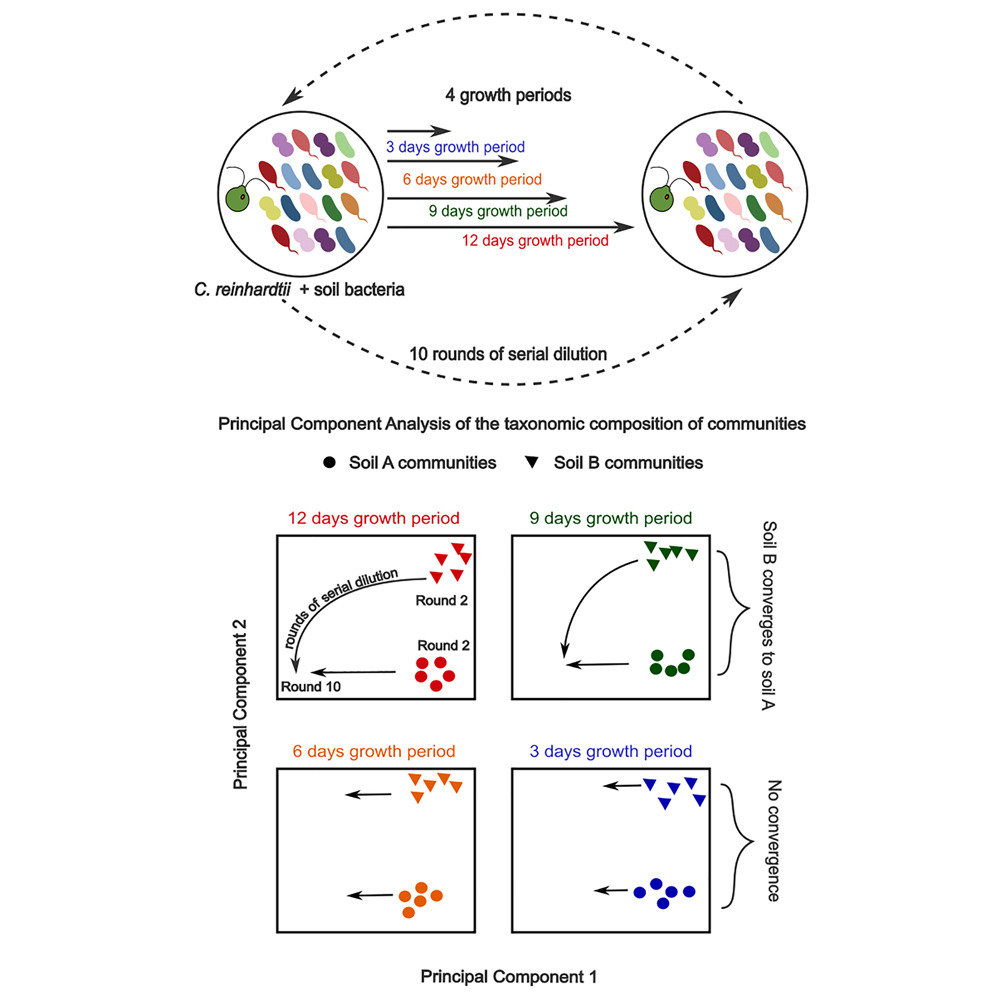
Microbial community assembly is a complex dynamical process that determines community structure and function. The interdependence of inter-species interactions and nutrient availability presents a challenge for understanding community assembly. We sought to understand how external nutrient supply rate modulated interactions to affect the assembly process. A statistical decomposition of taxonomic structures of bacterial communities assembled with and without algae and at varying dilution frequencies allowed the separation of the effects of biotic (presence of algae) and abiotic (dilution frequency) factors on community assembly. For infrequent dilutions, the algae strongly impact community assembly, driving initially diverse bacterial consortia to converge to a common structure. Analyzing sequencing data revealed that this convergence is largely mediated by a decline in the relative abundance of specific taxa in the presence of algae. This study shows that complex phototroph-heterotroph communities can be powerful model systems for understanding assembly processes relevant to the global ecosystem functioning.
Data availability
Sequence data (16s amplicon sequencing) and other datasets have been deposited at Zenodo and are publicly available as of the date of publication. Accession numbers are listed in the key resources table.
This paper does not report original code.
Any additional information required to reanalyze the data reported in this paper is available from the lead contact upon request.
Files
Algae-drive-convergent-bacterial-community-assembly-at-low-dilution-frequency.pdf
Files
(10.3 MB)
| Name | Size | Download all |
|---|---|---|
|
md5:ebc6196b7c18ab2ca5a88e5d9c0d7af3
|
135.9 kB | Preview Download |
|
Supplemental information md5:d8537152b3884e07ac397f5537cbf229 |
5.5 MB | Preview Download |
|
Article md5:1e62daef2eba3134e981f0f3f8ee913c |
3.6 MB | Preview Download |
|
md5:5b3562b58f6d96c238a2c51b302bc0e4
|
1.0 MB | Preview Download |
Additional details
Identifiers
- DOI
- 10.1016/j.isci.2023.106879
- Other
- oai:uchicago.tind.io:6266
Funding
- National Science Foundation
- BIO 2117477
- University of Illinois at Urbana-Champaign
- Center for Physics of Living Cells